
There is a distinct aroma that greets you when you step out of your car in Central Texas. It is not just the scent of cooked meat; it is the sweet, earthy perfume of Post Oak smoke drifting from a weathered smokehouse. For those of us in the culinary world, this smell is the hallmark of authenticity. It signals that someone is doing things the hard way, the right way — on a wood-burning grill.
Texas BBQ is more than a method; it is a religion built on patience, simple ingredients, and the absolute mastery of fire. While other regions rely on heavy sauces or complex marinades to mask the meat, Texas style-cooking celebrates the beef itself, elevated only by smoke and time. Achieving that legendary bark and melt-in-your-mouth tenderness requires understanding the interplay between airflow, heat, and wood.
Let’s explore how to bring that authentic Texas flavor to your restaurant or kitchen. We will walk through the selection of meats, the nuances of cooking with wood, and the specific techniques required to master brisket and ribs. Whether you are operating a commercial wood grill in a high-volume kitchen or refining your craft, the principles remain the same: respect the meat and respect the fire.
What Makes Texas BBQ Authentic
Authenticity in Texas BBQ is defined by simplicity. If you visit the hallowed pits of Lockhart or Austin, you will find that the seasoning profile is surprisingly minimal. The legendary “Dalmatian rub” — a simple mix of coarse black pepper and kosher salt — is often the only seasoning used. The goal is not to overpower the meat but to form a savory crust, known as “bark,” which absorbs the smoke flavor.
However, the true secret ingredient is the fuel. Authentic Texas BBQ is almost exclusively cooked on a wood-fired grill or offset smoker using indirect heat. Unlike gas or electric smokers, which can produce a sterile heat, a wood-burning grill adds layers of flavor compounds that simply cannot be replicated. The combustion of wood releases syringol and guaiacol, the chemicals responsible for that smoky aroma and taste.
When we talk about Texas authenticity, we are also talking about the “low and slow” philosophy. We are cooking at temperatures between 225°F and 275°F for anywhere from 12 to 18 hours for a full packer brisket. This slow rendering process allows the connective tissues to break down into gelatin, creating that succulent texture that Texas BBQ is famous for.
Prepare Your Brisket and Ribs
Preparation is where the battle is won or lost. For brisket, we always start with a full packer cut — containing both the flat and the point muscles. The trimming process is crucial. You want to remove the hard “deckle” fat that will not render, while leaving about a quarter-inch of the soft fat cap to protect the meat during the long cook. We also suggest creating a “Mohawk” cut on the point end to ensure the meat is aerodynamic, allowing smoke to flow smoothly over the surface without creating eddies that dry out the meat.
For ribs, specifically pork spare ribs or St. Louis cut, the prep is slightly less surgical but equally important. You must remove the silverskin membrane from the back of the ribs. If left on, this membrane becomes tough and prevents smoke from penetrating the meat. Use a paper towel to grip the membrane and peel it off in one clean pull.
Once trimmed, apply your binder. Yellow mustard is the traditional choice; it does not add flavor but helps the rub adhere. Then, coat the meat liberally with your salt and pepper mixture (usually a 50/50 ratio by volume). Press the rub into the meat but do not rub it off. Allow the meat to sit until the rub looks “wet,” indicating the salt is beginning to draw out moisture. This is the first step in forming the bark that is essential when cooking with wood.
Select The Right Wood for Flavor
The wood you choose acts as a seasoning ingredient just as much as salt or pepper. In Texas, Post Oak is the king. It burns with a clean, mild smoke that complements beef without overpowering it. It provides a steady, consistent heat source that is perfect for the long durations required on a wood-fired grill.
If you are looking for a punchier flavor, Mesquite is the wood of choice in West and South Texas. However, Mesquite burns hot and fast and produces a thick, acrid smoke if not managed carefully. We recommend burning Mesquite down to coals before adding it to your firebox, or using it in combination with a milder wood to temper its intensity.
Hickory and Pecan are also excellent choices. Hickory offers a strong, bacon-like flavor that pairs beautifully with ribs, while Pecan provides a subtle sweetness. When using a commercial wood grill, consistency is key, so sourcing high-quality, seasoned logs (not green wood) is vital. Green wood contains too much moisture and produces thick, white smoke — often called “dirty smoke” — which leaves a bitter creosote taste on the food. You want “thin blue smoke,” which is almost invisible and smells sweet.
Common Mistakes To Avoid
Operating a wood-burning grill requires vigilance, and there are several pitfalls that can ruin a cook.
- Looking, Not Cooking: Every time you open the lid of your wood-fired grill, you lose heat and humidity. This extends the cooking time and causes temperature fluctuations that can dry out the meat. Trust your thermometers and leave the lid closed as much as possible.
- Rushing the Stall: The “stall” is a phenomenon where the internal temperature of the meat plateaus around 160°F as surface evaporation cools the meat. Many inexperienced cooks panic and crank up the heat. Instead, this is the time to wrap the meat. Use pink butcher paper (peach paper) rather than aluminum foil. Paper allows the meat to breathe and preserves the bark, whereas foil steams the meat and can make the bark mushy.
- Slicing Too Soon: This is perhaps the most tragic mistake. After a brisket comes off the grill at 203°F, it must rest. During the cook, the muscle fibers contract and squeeze juices to the center. Resting allows the fibers to relax and the juices to redistribute. We recommend resting a brisket for at least two hours—preferably four—in an insulated cooler (faux Cambro) before slicing.
- Ignoring Fire Management: On a commercial wood grill, you cannot simply set it and forget it. You must maintain a clean fire. If your fire is smoldering, you are generating bad smoke. You need a small, hot fire with plenty of airflow to ensure complete combustion.
Serving Texas BBQ the Right Way
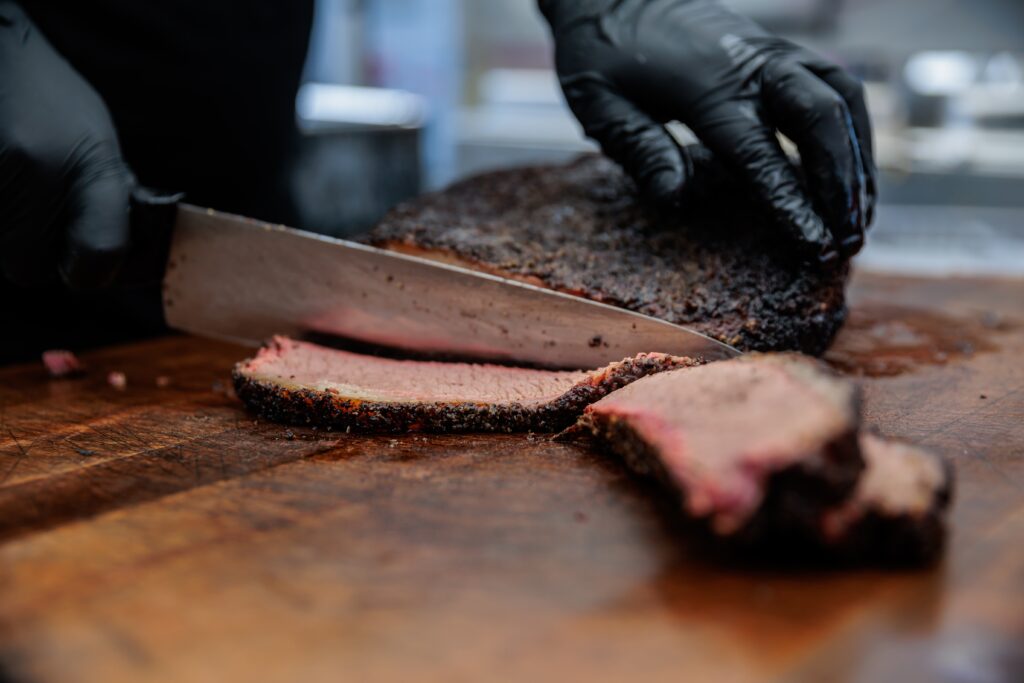
Presentation is the final step in the journey. When slicing brisket, separate the point from the flat. Slice the flat against the grain in pencil-thick slices. The point is fatty and luscious; cut it into larger chunks or slice it across the grain as well. The meat should hold its shape when held up but pull apart easily with a gentle tug — the famous “pull test.”
Ribs should be sliced bone-by-bone. A properly cooked rib will not fall off the bone entirely; it should have a clean bite where the meat pulls away from the bone only where you bit it. “Fall off the bone” usually implies overcooked, mushy ribs.
Serve your meats with classic Texas sides: white bread (to sop up juices), pickles and onions (to cut the richness), and perhaps a side of beans or potato salad. Sauce should always be served on the side, never pre-glazed. The flavor of the wood-burning grill should stand on its own.
Grill the Right Way with Aztec Grills
To consistently produce this level of quality in a professional setting, your equipment must be up to the task. This is where Aztec Grills excels. Since 1982, Aztec Grill has been the standard for commercial wood grill systems, engineering units that withstand the intense heat and durability requirements of a commercial kitchen.
Aztec Grills allow chefs to harness the primal power of wood fire with modern precision. Their heavy-duty construction ensures that you can maintain the stable temperatures necessary for low-and-slow smoking or high-heat searing. Whether you are looking for a compact unit or a massive showpiece for your open kitchen, Aztec Grill offers a variety of sizes to fit your needs, including the ST-30 (30 inch), ST-36 (36 inch), ST-42 (42 inch), ST-48 (48 inch), ST-54 (54 inch), and the expansive ST-66 (66 inch).
By investing in a high-quality wood-fired grill, you are not just buying equipment; you are investing in flavor, consistency, and the authentic tradition of Texas BBQ.
Mastering Texas-style brisket and ribs on a wood-burning grill is a journey that rewards patience and attention to detail. From the careful trimming of the brisket to the selection of aged Post Oak, every step contributes to the final product. By avoiding common mistakes and respecting the process of cooking with wood, you can create barbecue that rivals the best pits in the Lone Star State.
Remember that the heart of this cooking style is the fire itself. The right equipment makes that fire manageable and consistent. We encourage you to embrace the challenge and the flavor that only wood fire can provide.
Ready to elevate your restaurant’s menu with the authentic taste of wood-fired cooking? Visit Aztec Grill today to explore our range of commercial wood grill models and find the perfect fit for your kitchen. Contact us to discuss how we can help you bring the heat.
FAQ
Q. What is the best temperature for smoking brisket on a wood-burning grill?
The ideal temperature range for smoking brisket is between 225°F and 250°F. This “low and slow” temperature allows the collagen in the meat to break down slowly, rendering the fat and making the meat tender without drying it out. If you are running a hotter fire on a wood-fired grill, you can go up to 275°F, but you must monitor the bark closely to prevent burning.
Q. How long should I rest a brisket after cooking?
You should rest a brisket for a minimum of 2 hours, though 4 hours is often considered optimal. Resting allows the internal juices, which are constricted during the cooking process, to redistribute throughout the meat. If you slice into it immediately, the juices will run out, leaving you with dry brisket. Keep it wrapped and placed in an insulated cooler (dry, no ice) to maintain a safe serving temperature during the rest.
Q. Can I use a commercial wood grill for both smoking and grilling?
Yes, a high-quality commercial wood grill, like those from Aztec Grill, is versatile enough for both direct grilling and indirect smoking. By managing your fire and utilizing different heat zones or raising the grate height, you can sear steaks at high temperatures or maintain the low, consistent heat required for smoking ribs and brisket. Cooking with wood offers this versatility while adding superior flavor profile to any dish.